
No Permanent Workbench? Plan a Workspace That Packs Away
A garage can be a workshop on Saturday morning and a parking space again that evening. A spare room may need to return to everyday use even sooner. If you cannot leave a workbench in place, the buying decision is about more than finding something that folds.
You need room for the work, somewhere to keep the equipment afterwards and a realistic way to move between the two. Planning those details first makes it easier to choose folding supports or clamps for small assembly and household projects.
Pause if you cannot provide stable support, secure the work appropriately or keep the surrounding route clear. A folding design does not make an unsuitable location safe.
Make room for the work, storage and unfinished project
- The working space: allow for the open supports, the workpiece and access to the parts you need to reach.
- The storage space: check where the folded equipment, clamps and any separate worktop will go.
- The route between them: consider doors, corners and whether you can move each item comfortably.
- The unfinished project: decide where it can remain if the job takes longer than expected.
These checks are useful whether you are considering a folding workbench or a pair of sawhorses. The arrangement needs to work at the beginning and end of the job, not just while the tools are out.
Make sure the equipment suits the task
Choose supports and any separate worktop as a suitable arrangement for the job. Follow the instructions for the exact equipment, including permitted layouts and load limits, rather than guessing timber sizes or support spacing.
If the job involves machinery, heavy materials or a method you have not used before, establish the task-specific support and safety requirements first. Do not assume that a surface suitable for assembling a small item is also suitable for cutting, drilling or mounting a machine.
Supporting the work and holding it are different jobs
A sawhorse provides support beneath suitable material. A clamp applies pressure to hold suitable pieces or components in position. Buying one does not automatically solve the job of the other.
For example, you may have enough support beneath a board but still need a suitable way to prevent unwanted movement during the task. Equally, a clamp cannot compensate for an unstable base. Consider support, restraint and access separately before selecting equipment.
Folding sawhorses: check the open arrangement as well as storage
The Roughneck Colt folding steel sawhorse twin pack provides two supports with independently adjustable legs and extendable timber supports. The folding format is relevant when the equipment must be put away between jobs.
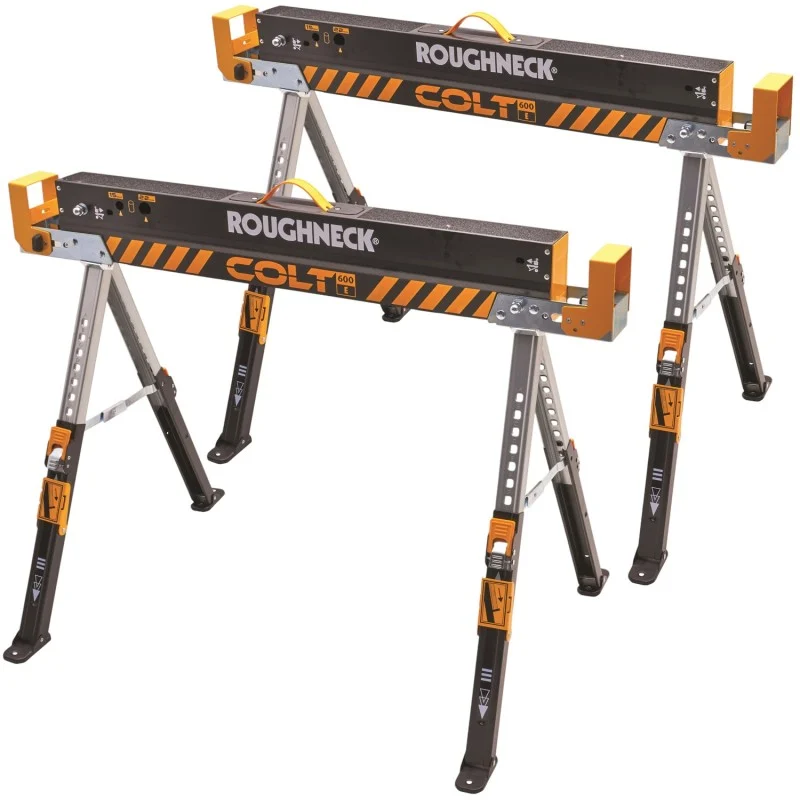
Before choosing the pair, confirm the dimensions when open and folded, along with the weight of each item you will need to move. Compare those details with your actual storage space and the route to the working area. Do not assume that a folding product will fit a narrow cupboard or pass easily around a tight corner.
Roughneck describes the timber supports as allowing a pair to form the base of a worktable. The twin pack does not include a finished tabletop, so check the additional materials and instructions needed before budgeting for a complete bench.
Follow the manufacturer’s conditions for any stated load rating. The rating for the supports alone does not establish the capacity of a separate tabletop or a complete homemade bench.
Clamps: check where the jaws need to reach
The IRWIN 300mm quick-change clamp and spreader twin pack includes two one-handed bar clamps. The clamps can also be converted to spreaders. For ordinary clamping, the useful buying check is whether the jaws can reach and hold the intended parts.
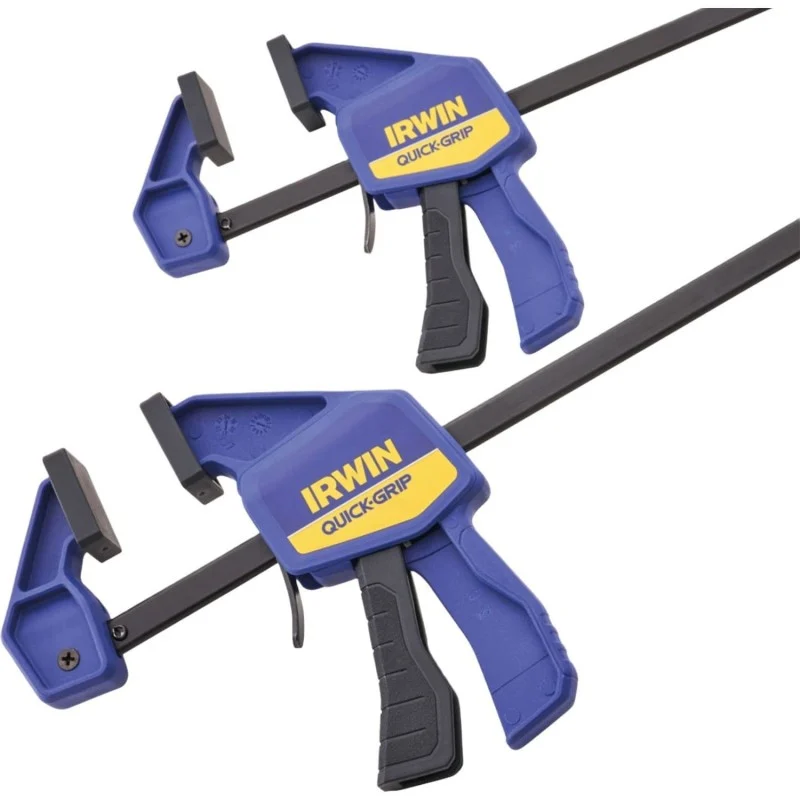
The 300mm clamping capacity describes the opening between the jaws. It is not the depth that the jaws can reach in from an edge. Check both the opening needed and the position of the contact points, particularly where a lip, frame or other obstruction is in the way.
Also consider where the bar and handle will sit. A clamp that fits the material can still obstruct a fastening point or project into a walkway. The layout needs to leave room for the actual task, not just accommodate the clamp.
Choose around the way your space is shared
You need the room back after every session
Think about storage as well as working size. Find a place for each support, clamp and separate surface. If the tabletop has no practical storage position, the fact that the legs fold will not solve the whole problem.
A purpose-made folding workbench may be worth comparing with separate supports when you want fewer loose components. Check the exact bench’s suitability and capacity rather than assuming every folding bench serves the same tasks.
You have a garage but only a narrow clear area
Measure the usable space with the door, cupboards and any other items in their normal positions. The full floor area is not necessarily the area available for work. Include room to approach the workpiece and reach the points involved in the task without squeezing past equipment.
If the planned arrangement blocks the exit or leaves no sensible access, pause and change the location or approach. Choosing smaller supports does not necessarily solve the space needed by a long or wide workpiece.
The job may need to stay in place overnight
Allow for waiting time as well as active working time. An adhesive may require the assembly to remain undisturbed for the period specified in its instructions. A partly finished item may also be awkward to move.
Decide where that work can remain before borrowing a space that must be cleared the same evening. If there is no suitable location, change the timing or split the project into manageable stages rather than relying on being able to move everything immediately.
Measurements worth taking before you shop
A few measurements and notes can make product comparisons much more useful:
- Task: describe the next project and the type of support or holding it needs.
- Workpiece: record its overall dimensions and any areas that need to remain accessible.
- Working area: note the usable floor space and obstacles, not just the room dimensions.
- Equipment: check the open and folded dimensions, handling weight and separate components.
- Storage: identify a suitable position for every part, including the worktop if required.
- Time: record when the space must return to normal use and whether the work can safely remain there.
Use those measurements to ask specific questions. “What are the folded dimensions?” or “What additional parts are required for the worktable arrangement?” is easier to resolve than asking whether a product is generally good for a small garage.
If a dimension or instruction is missing, get it confirmed before ordering. A photograph can help explain a feature, but it cannot establish that the product will fit your storage position.
Small-space mistakes worth avoiding
Buying around the folded size alone. Equipment can store neatly and still need more working room than you have available.
Forgetting the separate surface. Folding supports and a large rigid worktop have different storage needs. Include both in the plan.
Leaving clamps until last. Jaw access, bar position and the task itself need considering together. Do not assume any clamp will work wherever support is available.
Treating clamping force as a supported weight. A clamp’s pressure figure is not a lifting capacity or a load rating for the workbench. Use equipment only for its intended purpose.
Planning only for a finished project. An unfinished assembly can occupy more room than the folded tools. Allow for delays and any required curing time.
Make packing away part of the routine
Follow the supplied instructions for folding, cleaning and storage. Check the equipment for damage before its next use, including locking parts and clamp pads. Take damaged or unreliable equipment out of use until the issue is resolved.
Keep small accessories and instructions in an identified place so they can be found when the equipment comes out again. Store the separate components securely, without obstructing access or leaving them where they could fall.
After the first project, review what was awkward. If moving a worktop was the difficult part, buying more clamps will not address that problem. Let the experience of using the space guide the next purchase.
What to Buy and Where to Get It
The Roughneck supports and IRWIN clamps at Path & Patio serve different purposes: the supports sit beneath the work, while the clamps hold suitable parts in position. Compare the linked product details with your measurements and the work you have planned.
Check the current contents, dimensions, instructions, price and availability. Ask about any missing information before buying additional timber or a separate surface. If a complete folding bench would better suit the task and storage space, include that option in your comparison.
Summary
A workspace that packs away needs a plan for the open equipment, the stored components and the unfinished project. Choose supports and clamps around those needs, and keep the manufacturer’s limits separate from assumptions about a finished workbench.
Frequently Asked Questions
Can I buy the supports before choosing a worktop?
You can compare supports first, but establish the permitted worktable arrangement and the additional components before purchasing. Otherwise, you may choose supports that do not suit the surface or storage space you intend to use.
Do I need two clamps for every project?
A twin pack describes the quantity supplied, not the number required for every job. The workpiece, contact points and task determine the appropriate holding arrangement. Seek guidance if you cannot establish how to hold the work securely.
What if the equipment fits but I cannot move it comfortably?
Reconsider the storage position, access route or equipment choice before buying. An arrangement that depends on an awkward move every time may be unsuitable for a shared space, even when its dimensions fit.

Path & Patio is a UK supplier of paving and landscaping products, sharing practical guidance, product expertise and installation advice for patios, paths and driveway projects.