
Weeding Tools Compared: Hoes, Hand Weeders, Joint Scrapers and Electric Weeders
Weeding is quicker when the tool matches the job. Surface weeds, deep roots, paving joints, overgrown grass and hardstanding weeds all need different approaches. A hoe can be efficient in open soil, but it will not remove a deep taproot cleanly. A joint scraper can clear paving gaps, but it is not made for wide border clearance. A weed slasher can tackle rough overgrowth, but it is too blunt an answer for delicate beds.
The safest approach is to identify the weed, the surface and the level of regrowth before choosing a tool. Manual and non-chemical methods should usually be considered first, especially around edible plants, pets, wildlife areas and drainage routes. Weedkiller can be useful in some cases, but it should be used only where the label clearly matches the weed, surface and location.
For weed-control products, manual weeding tools, sprayers and related garden maintenance options, use Weed Killer and Weeding. Choose by weed location, root type, surface material and safety risk.
Quick Answer: Which Weeding Tool Should You Use?
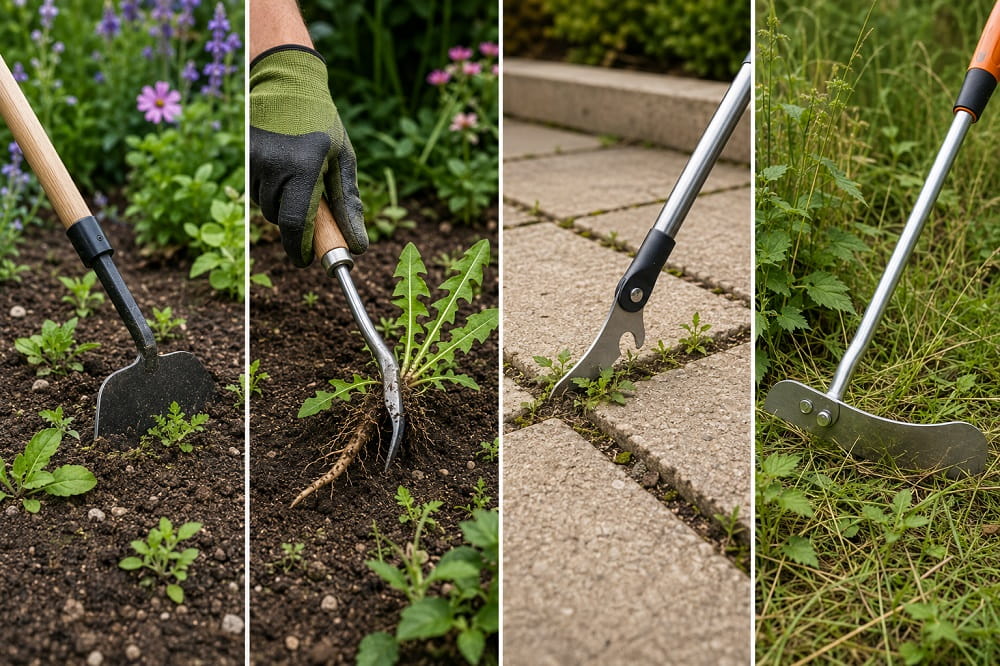
- Safest default: use manual weeding first, where practical, then escalate only if the weed type or scale requires it.
- Use a hoe for young, shallow annual weeds in open beds and borders.
- Use a hand weeder for individual weeds, taproots and weeds close to plants you want to keep.
- Use a joint scraper or patio weeder for weeds in paving joints, patio gaps, and block paving edges.
- Use a weed slasher for rough overgrowth such as long grass, nettles and brambles, not for fine root removal.
- Use electric weeders or weedkiller only where the surface, weather, safety conditions and product instructions support that method.
What This Guide Does Not Solve
This guide does not identify every weed species or provide specialist control advice for invasive plants such as Japanese knotweed, giant hogweed or other controlled or hazardous plants. If the plant is unknown, spreading aggressively or may require specialist handling, identify it properly before digging, cutting, burning or disposing of it.
This guide also does not replace product labels or tool instructions. Weedkillers, electric weeders, heat tools, scrapers, slashers and sprayers all have specific instructions and risks.
Finally, this guide does not promise permanent weed prevention. Seeds blow in, roots regrow, paving joints collect debris and bare soil invites new seedlings. The right tool helps, but prevention depends on routine maintenance as well.
When to Pause or Escalate
Stop before cutting, digging or treating weeds if you cannot identify the plant, if it may be invasive, or if it is growing near cables, irrigation, ponds, pets, children’s play areas or edible crops. The wrong method can spread roots, damage surfaces or create avoidable safety risks.
Pause before using weedkiller unless the label clearly allows use on the target weed, surface and location. The HSE garden pesticide guidance should be followed where chemical products are used.
Escalate to professional help if weeds repeatedly return from deep roots, if paving is lifting, if tree roots are involved, if weeds are spreading through boundaries, or if the plant may need specialist disposal.
Why the Right Weeding Tool Matters
Surface weeds are different from deep-rooted weeds
Young annual weeds in loose soil are usually quick to remove while small. A hoe can slice through seedlings before they seed. Deep-rooted weeds are different. If the root snaps near the surface, the weed may regrow.
Paving joints need precision
Weeds in paving joints grow in trapped dust, sand, moss and organic debris. A broad tool can damage the joint or surface. A dedicated joint scraper or patio weeder targets the gap more precisely.
Overgrown areas need clearance tools
Long grass, brambles and nettles are clearance jobs rather than fine weeding jobs. A slasher can help reclaim an overgrown edge or boundary, but it should not be confused with root removal.
Chemical application needs control
Where weedkiller is justified, accurate application matters. A sprayer can support targeted application, but the product label, wind conditions, nearby plants, pets and drainage all matter.
Weeding Tools Compared
Hoes
Hoes are best for shallow-rooted annual weeds in open beds and borders. They work by slicing or disturbing young weeds near the soil surface. They are efficient over larger areas and work best when weeds are small and the soil is dry enough for uprooted seedlings to wilt.
Hoes are less suitable for deep-rooted weeds, paving joints and weeds growing close to delicate plants. They can also spread parts of some perennial weeds if used carelessly.
Hand weeders
Hand weeders are best for individual weeds, taproots and weeds close to plants you want to keep. They give more control than a hoe and can remove roots more thoroughly when used carefully.
The drawback is speed. Hand weeding is slower across large areas and can be tiring if the soil is compacted. For deep roots, the aim is to remove as much root as possible rather than snapping it near the surface.
Joint scrapers and patio weeders
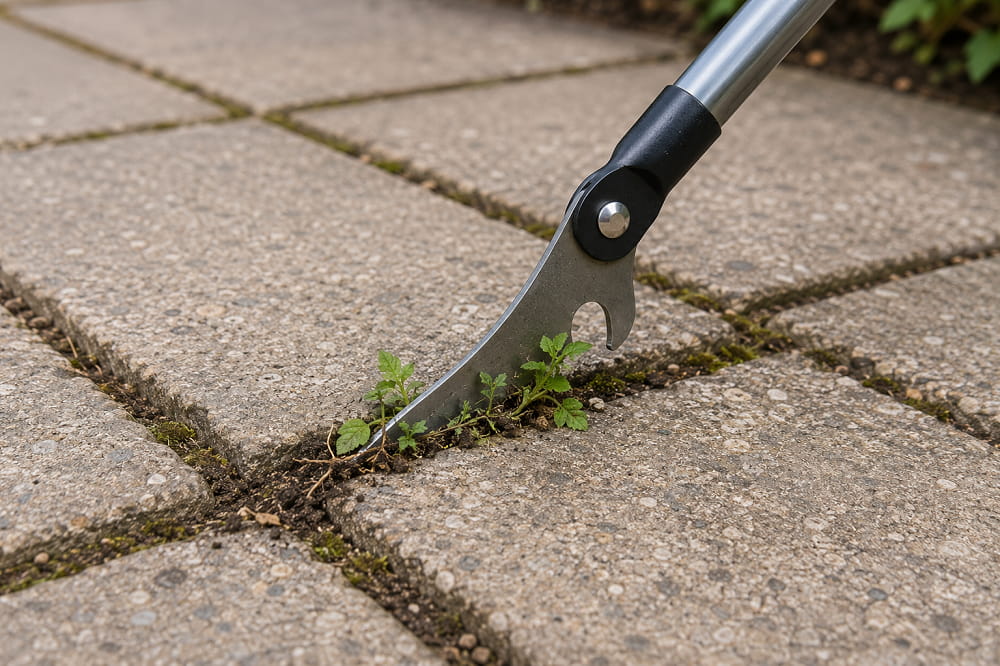
Joint scrapers and patio weeders are designed for paving joints, patio gaps, block paving edges and hard-to-reach cracks. They remove weeds and debris from narrow gaps where a hoe or fork will not fit.
For a Path & Patio product example, the Garden Pro Telescopic Long Handle Hooked Patio Weeder is designed for patios, driveways, block paving and tight spaces, with a telescopic handle to reduce bending and kneeling.
Weed slashers
Weed slashers are for rough clearance rather than precision weeding. They are useful for long grass, nettles, brambles and neglected edges where a hand tool would be too slow.
For a Path & Patio product example, the Garden Weed Slasher is built for clearing overgrown grass, brambles and nettles. It is useful for reclaiming rough areas before finer weeding or treatment, but it does not remove roots cleanly.
Electric weeders
Electric weeders can be useful for selected surface weeds on hardstanding or in garden areas where manual scraping is impractical. Some use heat, while others use powered mechanical action. Their suitability depends on the surface, weather, cables, flammable materials and user control.
Electric weeders should not be treated as automatically safer than manual tools. They may weaken top growth rather than removing deep roots, and heat-based tools need particular care around dry grass, mulch, timber edging, pets and children.
Sprayers for weedkiller application
A sprayer is not a weeding tool in the same sense as a hoe or scraper, but it is part of the weed-control toolkit where chemical treatment is justified. It can support controlled application over larger or targeted areas.
For a Path & Patio product example, the Kingfisher 3L Sprayer is described as suitable for applying pesticides and distributing weed killers in gardens or greenhouses. Use it only with products and locations supported by the relevant label.
Comparison Table: Weeding Tools and Product Examples
| Tool type | Best for | Weakness | Path & Patio example | Risk point |
|---|---|---|---|---|
| Hoe | Young annual weeds and surface weeds in open soil | Poor for deep roots and tight gaps | Use the Weed Killer and Weeding category to browse current manual options | Can damage wanted plants or spread roots if used carelessly |
| Hand weeder | Individual weeds, taproots and weeds near wanted plants | Slow for large areas | Use the Weed Killer and Weeding category to browse current hand-tool options | Root snapping can cause regrowth |
| Joint scraper / patio weeder | Paving joints, patios and block paving gaps | Not suited to large soil areas | Garden Pro Telescopic Long Handle Hooked Patio Weeder | Can disturb weak jointing if used aggressively |
| Weed slasher | Overgrown grass, brambles, nettles and rough edges | Does not remove deep roots cleanly | Garden Weed Slasher | Sharp blade and clearance risk around people, pets and wanted plants |
| Electric weeder | Selected surface weeds where manual scraping is too slow | Not ideal for deep roots | Use category route if available stock changes | Heat, electricity, cable, surface and weather risks |
| Sprayer | Controlled weedkiller application where justified | Not a removal tool by itself | Kingfisher 3L Sprayer | Label compliance, drift, pets, edible crops and disposal |
Decision Framework: Which Tool Should You Choose?
1. Where is the weed growing?
Use a hoe for open soil, a hand weeder for individual rooted weeds, a patio weeder for paving gaps, and a slasher for rough overgrowth. Hard surfaces, borders and lawns should not be treated as the same job.
2. Is the weed shallow or deep-rooted?
Shallow annual weeds are usually easier to hoe or scrape. Deep-rooted weeds need targeted root removal. If you only cut the top off a deep-rooted weed, it may regrow.
3. Is the surface easy to damage?
Old paving joints, loose block paving, delicate planting and lawn edges can be damaged by aggressive tools. Use controlled pressure and avoid widening joints unnecessarily.
4. Is chemical control really needed?
The supports methods such as hoeing, hand weeding, repeated cutting, smothering and barriers. Consider these before chemical control, especially where biodiversity, pets, children or drainage are concerns.
5. Is the method safe today?
Pause before using electric weeders, heat tools or weedkiller in wet, windy, very dry or crowded areas. Conditions can change the safety of the method. Manual tools are often the safest option when control is more important than speed.
Step-by-Step: Match the Tool to the Weed
Step 1: Identify the location
Decide whether the weed is in a bed, border, lawn, gravel, paving joint, patio gap or driveway edge. The location usually narrows the tool choice quickly.
Step 2: Check the root type
Look at whether the weed is a small seedling, a spreading surface weed or a deep-rooted plant. Pull one example carefully if you are unsure.
Step 3: Choose the lowest-risk tool
Start with the most controlled manual option. Use a hoe for shallow soil weeds, a hand weeder for deep individual weeds and a joint scraper for hard-surface gaps.
Step 4: Remove debris
After removal, sweep or collect the debris. Leaving soil, roots and leaves in paving joints can encourage more weeds.
Step 5: Monitor regrowth
If the same weed regrows, reassess the root system, surface condition and whether a different method is needed.
Step 6: Use weedkiller only where justified
If manual methods are not practical or the weed repeatedly returns, consider a suitable authorised weedkiller only where the label matches the location and use case. Follow the label exactly.
Common Mistakes
Using a hoe on deep-rooted weeds
A hoe may remove the top growth but leave the root behind. For deep roots, use a hand weeder or fork-type tool where suitable.
Scraping paving joints too aggressively
Joint scrapers are useful, but excessive force can disturb weak jointing or widen gaps. Work carefully and clear debris afterwards.
Waiting until weeds set seed
Young weeds are easier to remove. Regular light weeding usually beats occasional heavy clearance.
Using a slasher where root removal is needed
A weed slasher can clear top growth quickly, but it does not remove deep roots. Use it for clearance, then follow up where regrowth is likely.
Assuming electric weeders remove roots
Many electric weeders weaken top growth rather than removing the full root system. Deep-rooted perennial weeds may regrow.
Using weedkiller as the first answer
Weedkiller may be useful in some cases, but it should not automatically replace hoeing, hand weeding, scraping and prevention.
Maintenance and Prevention
Weeding is easier when it becomes routine. Hoe young weeds before they establish. Remove deep-rooted weeds before they flower. Sweep patios and paths so soil does not collect in joints. Keep gravel topped up and edged so weeds have fewer sheltered pockets.
In paving, prevention is often about removing the growing medium. Leaves, dust, soil and moss collect in gaps and create a place for seeds to establish. Regular sweeping and joint maintenance reduce the workload later.
In borders, dense planting and mulching can reduce bare soil where annual weeds germinate. For persistent perennial weeds, repeated removal may be needed over time.
Your Next Step: DIY or Professional
DIY weeding is usually suitable for ordinary annual weeds, patio-joint weeds, lawn weeds, border weeds and routine garden maintenance. Choose the tool by surface and root type rather than buying the most aggressive option first.
Professional help is more appropriate where weeds are invasive, extensive, growing through hard landscaping, lifting paving, spreading through boundaries, or returning from deep root systems that cannot be controlled with ordinary tools.
The right tool saves time because it matches the job. Hoes cover open soil quickly. Hand weeders target roots. Patio weeders clean paving gaps. Slashers clear rough growth. Sprayers support controlled treatment only where weedkiller is justified.
Summary
Hoes, hand weeders, joint scrapers, slashers, electric weeders and sprayers all have a place. A hoe is efficient for small surface weeds in open soil. A hand weeder is better for individual deep-rooted weeds. A joint scraper or patio weeder is best for weeds in paving gaps. A weed slasher is for overgrown rough areas. An electric weeder may help with selected surface weeds where conditions are safe.
The safest default is to start with controlled manual methods. Use weedkiller only when justified, authorised for the use case and clearly supported by the label. Weeding works best when removal is combined with prevention: sweeping, mulching, edging, joint maintenance and regular inspection.
Frequently Asked Questions
What is the best tool for weeding paving joints?
A joint scraper or patio weeder is usually best because it can reach narrow gaps between slabs, block paving and patio edges without disturbing the whole surface.
What is the best tool for deep-rooted weeds?
A hand weeder, fork or root-removal tool is usually better than a hoe. The goal is to remove as much of the root as possible to reduce regrowth.
Are hoes good for weeding?
Yes, hoes are useful for young surface weeds in open soil. They are less suitable for deep-rooted weeds or weeds growing close to delicate plants.
When should I use a weed slasher?
Use a weed slasher for overgrown grass, brambles, nettles and rough clearance jobs. It is not the best tool for precise root removal.
Do electric weeders kill roots?
Not always. Many electric weeders weaken surface growth rather than removing the full root system. Deep-rooted perennial weeds may regrow.
Should I use weedkiller instead of tools?
Not as the first option. Try manual and non-chemical methods where practical. Use weedkiller only when needed and only according to the label.
How do I stop weeds coming back in paving joints?
Remove roots and debris, sweep regularly, keep joints maintained and avoid allowing soil and leaf litter to collect in gaps.
When should I get professional weed-control help?
Get help if weeds may be invasive, are lifting paving, spreading through boundaries, returning from deep roots, or covering a large area that ordinary tools cannot manage safely.

Path & Patio is a UK supplier of paving and landscaping products, sharing practical guidance, product expertise and installation advice for patios, paths and driveway projects.