
Patio and Driveway Sealer Types Explained (UK): Wet Look vs Matt, Breathable vs Film-Forming, Solvent-Free vs Solvent-Based
Patio and driveway sealers can make paving easier to clean, reduce staining, and help surfaces look better for longer. They can also go wrong in predictable ways: white haze, patchy sheen, peeling, or a finish that feels slick when wet. Most problems come from choosing the wrong sealer family for the surface and moisture conditions, or applying it too soon, too thickly, or onto residue.
This guide is a practical UK-focused decision manual. It explains the main sealer types, the finishes they produce, how “breathable” claims relate to real damp and efflorescence issues, and what “solvent-free” means in day-to-day use. You will also get a step-by-step preparation and application method, plus troubleshooting for common failures.
Quick answer: how do you choose the right patio or driveway sealer?
- Decide first whether you want a visible finish change or a natural appearance.
- If moisture may still be present, prioritise breathable, non-film-forming sealers.
- Use film-forming wet look or satin sealers only on fully dry, well-drained surfaces.
- Always match the sealer to the surface type and slip-risk level.
Who this guide is for (and when sealing is the wrong step)
This guide is written for UK homeowners and competent DIY users choosing patio or driveway sealers as part of routine surface protection and maintenance.
This guide is not suitable for:
- Fixing structural movement, sinking or poor falls
- Solving persistent damp or drainage problems
- Sealing over loose joints, unstable paving or uncured installations
When to pause or seek professional advice
If paving is new, remains damp for long periods, or shows signs of moisture-related issues such as efflorescence or repeated algae growth, sealing should be delayed or professionally assessed.
Quick Start: Choose the Right Sealer in Five Decisions
Before you read the deeper sections, use these five decisions to narrow your options. If you answer them honestly, you will avoid most mismatched purchases.
Decision 1: Do You Want a Visible Finish Change?
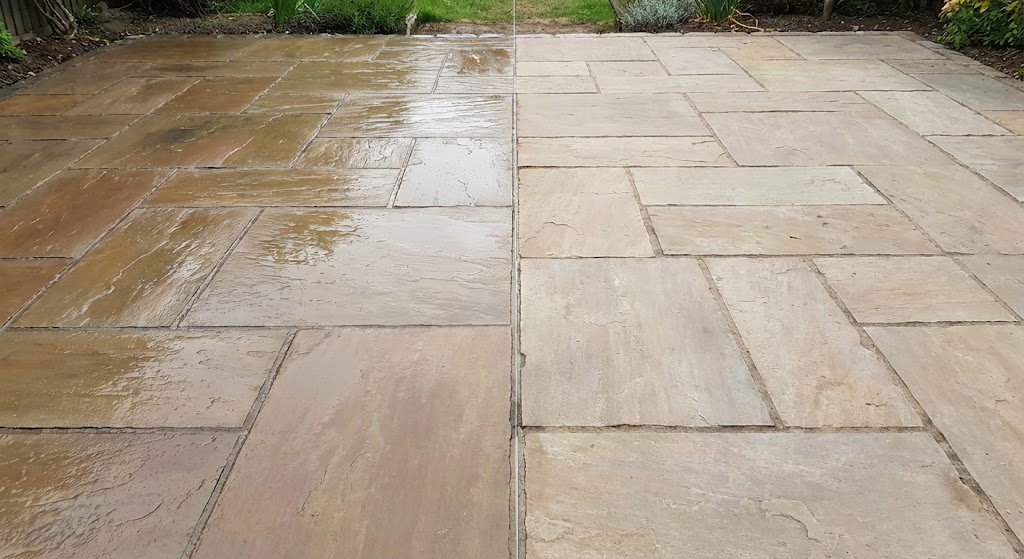
- No, I want it to look the same: start with an impregnating (penetrating) sealer marketed as “invisible” or “natural finish”.
- Yes, I want colour enhancement or shine: you are likely looking at a film-forming (topical) sealer (wet look, satin, or matt coating).
Decision 2: Is Moisture Likely to Be Present Under the Surface?
- High likelihood: new paving, shaded areas that stay damp, poor drainage, patios on fresh mortar beds, or any history of white salts. Prioritise breathable, non-film-forming options.
- Low likelihood: older, well-drained paving that dries quickly after rain. You have more freedom to choose a film-forming finish if you want it.
Decision 3: What Surface Are You Sealing?
- Block paving: decide whether joint sand stabilisation is a priority (often points toward a suitable film-former).
- Concrete flags or slabs: focus on porosity consistency and avoiding lap marks; impregnators are lower risk.
- Natural stone: test for colour change; breathable impregnation is often the safest default.
- Porcelain: sealing the tile is often unnecessary; if you seal, it is usually grout-focused and product-specific.
- Tarmac/asphalt: use specialist products only, not generic patio sealers.
Decision 4: Where Is the Slip Risk Highest?
If the sealed area includes steps, sloped driveways, ramps, or heavily used walkways, avoid high-gloss finishes unless you have a clear traction plan and the product is designed for that risk. If safety is the priority, a penetrating treatment that keeps the surface texture is commonly the safer route.
Decision 5: What Is Your Realistic Weather Window?
In the UK, many sealing failures are simply weather failures. If you cannot guarantee a stable dry window (including cool nights and dew), choose a lower-risk sealer family, reduce expectations on gloss, or delay the job.
What a Patio or Driveway Sealer Actually Does (and What It Does Not)
What Sealers Are Designed to Do
A sealer is a protective treatment applied to paving to reduce how quickly water, oils, dirt and organic contamination can penetrate. Many sealers also make routine maintenance easier because dirt and algae tend to release more readily when you wash the surface. On block paving, certain sealers are also used to help stabilise jointing sand so joints resist wash-out and disturbance.
What Sealers Cannot Do on Their Own
- They will not fix structural issues: rocking slabs, failed mortar beds, sinking blocks and poor falls must be repaired first.
- They will not permanently stop weeds: weeds can seed into surface debris. Sealing can reduce places weeds take hold, but maintenance still matters.
- They will not “waterproof” a bad drainage design: standing water and persistent damp create ongoing staining and growth problems regardless of sealer type.
The Two Main Sealer Families: Penetrating (Impregnating) vs Film-Forming (Topical)
Penetrating or Impregnating Sealers
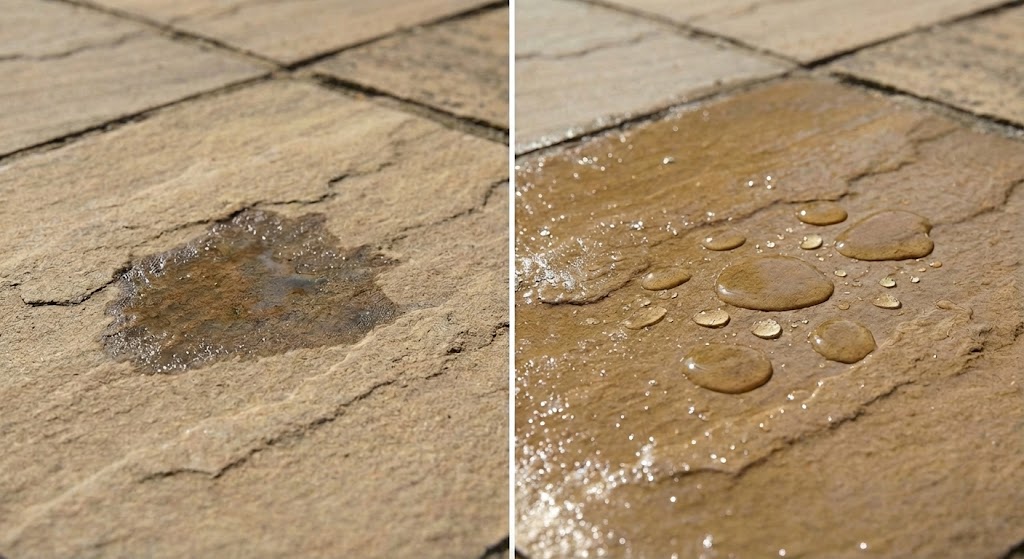
Penetrating sealers soak into the pores of the paving. Rather than creating a surface layer, they line the pore structure to reduce absorption. They are often sold as “natural finish” or “invisible” and are typically chosen when you want protection with minimal change to appearance and texture.
The biggest practical advantage for UK patios is that many impregnating treatments are marketed as non-film forming and breathable, meaning water vapour can still pass through the surface. That can be useful when the bedding layer or the paving itself is still drying, or where shaded areas stay damp and moisture needs to escape rather than be trapped under a surface film.
Film-Forming (Topical) Sealers
Film-forming sealers sit on top of the paving and cure into a protective layer. This is the family most associated with wet look and satin finishes. When they bond well and cure under good conditions, they can deliver strong stain resistance and an obvious visual upgrade.
The trade-off is sensitivity. If moisture is present under the surface, or if preparation is poor, the surface film can haze, whiten, peel, or look patchy.
How to Identify Which Family You Are Looking At
- Likely impregnator: “non-film forming”, “impregnating”, “breathable”, “vapour-permeable”, “natural finish”, “invisible”.
- Likely film-former: “wet look”, “gloss”, “satin”, “coating”, “forms a protective film”, “sand stabilising sealer”.
Finish Options: Wet Look, Satin, Matt, and Invisible
Wet Look: When It Works and When It Is a Bad Idea
Wet look sealers are chosen for colour enhancement. They deepen tones, increase contrast, and make paving look freshly washed. On many substrates, this means using a film-forming sealer, so you are also accepting the behaviour of a surface film.
Wet look tends to be a good fit when the surface is fully cured and dry through the system, drainage is good, and the area is not a high slip-risk zone. It is a poor fit when paving is new, shaded, regularly damp, or when you cannot control the weather window.
Satin or Low Sheen: A Compromise With Similar Rules
Satin finishes can look more natural than full gloss while still enriching colour. Many satin products are still film-forming, so the same moisture and application risks apply. The safest way to choose satin is to test a small, hidden area first and confirm the final sheen once fully cured.
Matt: Two Different Meanings
“Matt sealer” can mean either a matt coating (still film-forming) or an impregnating sealer that leaves the surface looking natural. Read for the behavioural words, not just the finish label. If it says it forms a film, treat it as a coating even if it dries matt.
Invisible: The Lowest-Risk Aesthetic Change
Invisible impregnators are often the safest first sealing step for mixed patios, natural stone, and areas where traction and patchiness are concerns. You can still improve stain resistance and ease of cleaning without taking on the extra risk that comes with a glossy film.
Breathability, Vapour Movement and Efflorescence Explained
Breathable vs Waterproof: A Practical Distinction
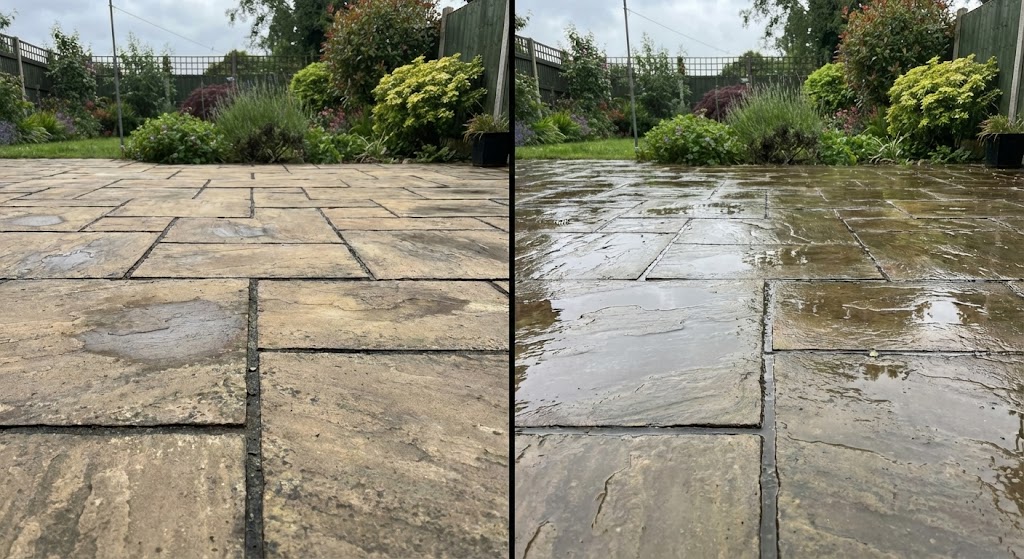
In paving terms, “breathable” usually refers to water vapour transmission, not liquid water. A breathable impregnator aims to reduce liquid water absorption from above, while still allowing moisture vapour to escape from within the paving or bedding layers.
Efflorescence: Why It Appears and Why Sealing Timing Matters
Efflorescence is the white or grey powdery deposit that often appears on new concrete products and some installations as they dry. It happens when moisture moves through the material and leaves salts on the surface as it evaporates. It is typically harmless but can be visually disruptive.
The key sealing insight is this: if you apply a low-quality or inappropriate film-forming sealer while the system is still drying, you can trap moisture in the substrate. Trapped moisture can contribute to hazing, whitening, blistering, and ongoing appearance issues. This is why new paving and damp-prone areas often benefit from breathable, non-film-forming approaches, or simply waiting longer before applying any topical finish.
Can You Seal Straight After Laying?
Some guidance states that sealing new natural stone or concrete paving straight after laying can be acceptable when using a breathable impregnator sealer, because it allows the bedding materials to continue drying. This is not a universal rule for all products and conditions. If you choose an early-seal approach, follow the specific product instructions, test a small area, and avoid film-forming wet look coatings until the installation is fully dry and stable.
Solvent-Based vs Solvent-Free vs Water-Based: What It Changes for Your Project
What “Solvent-Based” Means for Exposure and Handling
Many coatings contain solvents (VOCs). The practical issue is vapour exposure, especially when working close to the surface or spraying. Outdoors you have more ventilation than indoors, but sheltered courtyards, narrow side passages, or open doors and windows can still create exposure concerns. Treat solvent handling as a safety task, not just a smell issue.
What “Solvent-Free” Usually Means
“Solvent-free” commonly indicates a waterborne product or a formulation without traditional organic solvents. These products may be easier to use in residential settings because odour is lower and vapour exposure risk is reduced. It does not mean “risk-free”, and you should still use appropriate PPE and follow the product safety data.
Performance and Finish: Focus on the Outcome, Not the Label
It is tempting to use a simple rule like “solvent-based is stronger” or “water-based is safer”. In practice, you should decide based on your finish goal, moisture conditions and weather window. Some waterborne impregnators are ideal for breathable protection, while some high-gloss finishes are more commonly associated with solvent-based coatings.
Match the Sealer to the Surface: UK Use Cases and Selection Rules
Block Paving: Decide Whether You Need Joint Sand Stabilisation
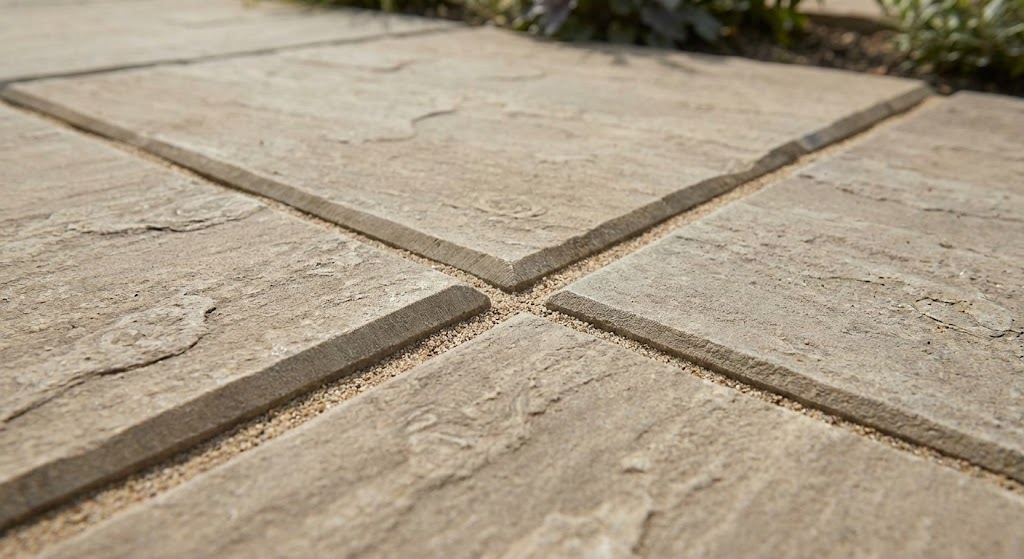
Block paving is commonly sealed to protect against stains, inhibit weed growth in joints, and stabilise jointing sand. If joint sand stability is important (for example, vehicle turning circles), you may prefer a block paving sealer designed for that purpose.
Lower-risk option: if you mainly want stain resistance and easier cleaning, a penetrating sealer may deliver enough benefit with fewer visible finish problems. Higher-risk option: a wet look film-former can look excellent but demands good dryness, careful application and consistent maintenance.
Concrete Flags and Slabs: Porosity Consistency Matters
Concrete flags vary in porosity across the patio, especially where some slabs are more weathered or were cleaned more aggressively. Film-forming sealers can highlight these differences as patchy sheen. If you choose a coating, test multiple slabs in different patio zones before committing. If you want lower risk, choose an impregnator and accept a more natural look.
Sandstone and Limestone: Test for Colour Change and Moisture Sensitivity
Many homeowners buy sealers because they want sandstone to “pop”. That is a valid goal, but sandstone and limestone can also show uneven absorption and colour enhancement. Always do a test patch, ideally on an offcut or an inconspicuous area, and allow full cure before judging the final look.
- Safer default: breathable impregnator, minimal change, easier maintenance.
- For colour enhancement: a compatible enhancer or wet look finish, but only once you are confident the substrate is dry and stable.
Slate, Granite and Denser Stones: Sealing Is About Staining and Maintenance
Denser stones absorb less water than softer sandstone. Sealing decisions are more often about oil staining, food and drink marks, and ease of cleaning. A penetrating treatment can still help, but you may see a smaller “before and after” compared with very porous stone.
Porcelain Paving: Sealing Is Often Unnecessary
Outdoor porcelain tiles are typically highly water resistant, so the tile surface itself often does not need sealing. When sealing is used, it is more commonly focused on grout lines, edges, or specific staining risks. If you decide to seal porcelain, choose a product designed for porcelain or dense surfaces, and treat traction as a first-order concern.
Tarmac and Asphalt: Use Specialist Products Only
Tarmac and asphalt require products designed for bituminous surfaces. Do not use generic patio or block paving sealers unless they explicitly state compatibility with asphalt. If the product is not designed for tarmac, choose a tarmac-specific system rather than taking a risk.
When to Seal: Curing, Drying, and Realistic UK Timing
New Paving: The “Looks Dry” Trap
New paving can be walkable quickly but still hold moisture in the bedding and joints. If you apply a film-forming sealer too soon, moisture migration can show up as haze or whitening. Even with impregnators, you will get better penetration and more consistent performance if the surface is clean and reasonably dry.
Older Paving: Contamination and Old Coatings Are the Main Risks
Older patios and driveways are more likely to have embedded algae, oil spots, detergent residues, or partial old sealers. These issues affect both appearance and bonding. If you suspect an old sealer, do a simple water test: if water beads strongly in some areas and soaks in elsewhere, expect uneven absorption and plan for stripping or a compatible system.
Weather Planning: What to Check Before You Start
- Rain: avoid sealing when rain is likely before initial curing has occurred.
- Dew: avoid late-day application in seasons where surfaces are likely to get wet again overnight.
- Temperature: cold nights slow curing and can increase the risk of surface defects.
- Sun and heat: very hot slabs can make coatings flash-dry, increasing lap marks.
Preparation: The Steps That Prevent Most Sealer Failures
Clean for the Contamination You Actually Have
“Pressure wash it” is not a preparation plan. You need to remove the specific contaminants that interfere with sealer performance:
- Algae and biofilm: treat properly and rinse until residues are gone.
- Oil and grease: use a suitable degreaser and rinse thoroughly.
- Detergent film: overuse of cleaning products can leave residues that cause patchiness. Rinse repeatedly until water runs clear and the surface feels residue-free.
- Jointing and grout haze: remove fully before sealing, especially on smooth paving where haze can be locked in.
Repair First: Do Not Seal Over Defects
Replace rocking slabs, re-bed loose blocks, and restore joints before sealing. If you need materials for that stage, use patio, path and driveway pointing products to rebuild joints before you protect the surface. On block paving, re-sand joints properly and remove loose sand from the surface before applying any sealer.
Drying: What “Dry Enough” Should Mean
Film-forming sealers generally require the surface and near-surface zone to be dry. Impregnators may be more forgiving but still perform best when moisture is not actively present at the surface. If in doubt, choose the worst-drying area of the patio (often shaded edges near walls) and test there first.
Application: Getting an Even Finish and Avoiding Lap Marks
Coverage Planning: Thin Coats Win
Over-application causes most visual problems. Apply thin, even coats and do not leave puddles. If a second coat is recommended, treat it as part of the system rather than trying to load the first coat heavily.
Choosing Roller, Sprayer or Brush
- Roller: best for most homeowners, easiest to control thickness and avoid overspray.
- Sprayer: fast but higher risk for uneven build and exposure, especially with solvent-based products.
- Brush: best for edges, verticals, and detailed work.
Work Pattern: Keep a Wet Edge and Split the Patio Into Zones
Plan your work so you always overlap into a wet edge. On large patios, split into zones using natural breaks (edgings, drainage channels, step lines). This reduces lap marks and sheen banding.
Slip Risk Management in Practical Terms
A sealed surface can still be slippery if it carries biofilm or detergent residue. If slip risk is a concern:
- avoid high-gloss finishes on slopes and steps
- prioritise a penetrating treatment that preserves texture
- maintain with regular cleaning to prevent organic build-up
Aftercare and Re-Coating: How to Keep Performance Without Creating a Build-Up Problem
Routine Cleaning
Keep debris off the surface. Leaves and soil feed algae and can stain porous paving even when sealed. Use cleaning products that are compatible with sealed surfaces and rinse thoroughly to avoid leaving films that mimic “sealer failure”.
When to Re-Coat
Do not guess a re-coat date. Look for performance signals:
- water stops beading where it previously did
- stains absorb more readily
- cleaning becomes harder again
- high-traffic lanes show visible wear first
Switching From a Coating to an Impregnator
If you have a film-forming wet look and decide you want a natural finish later, you usually need to remove the existing coating. Applying an impregnator over an intact film will not penetrate properly and performance will be disappointing. If long-term flexibility matters, starting with an impregnator is often the more reversible choice.
Troubleshooting: Common Failures and What to Do Next
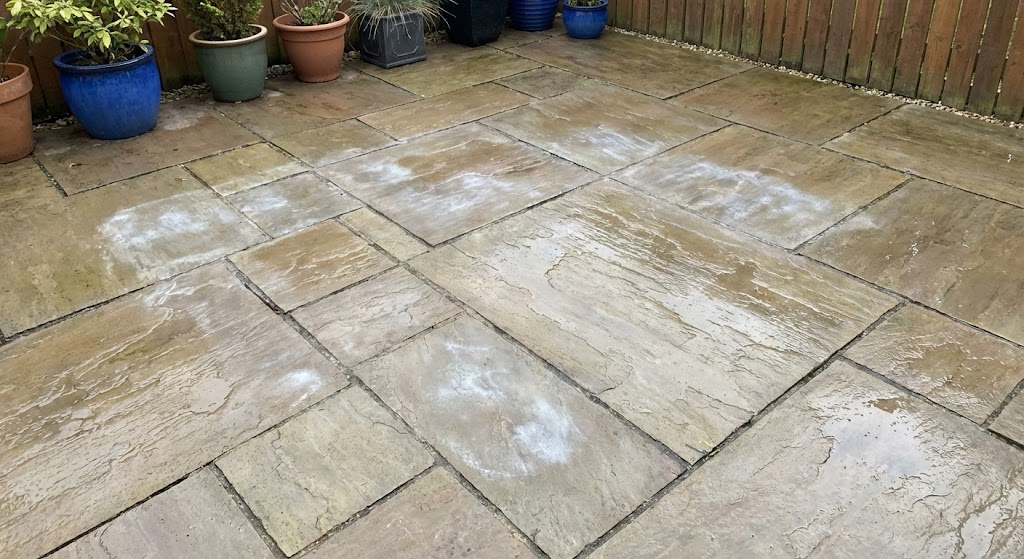
White Haze, Whitening or Bloom
Common causes include trapped moisture under a film-forming sealer, application in high humidity or dew conditions, or leaving excess product to dry on the surface. The right fix depends on the product: sometimes extra cure time improves the appearance, sometimes re-coating re-emulsifies the film, and sometimes stripping is required. Stop applying more product until the cause is understood.
Patchy Sheen and Roller Marks
Patchiness usually comes from uneven porosity (common on concrete flags and mixed stone) or inconsistent application thickness. Test patches across different slabs and apply in controlled zones with a wet edge. Thin coats and consistent coverage reduce the risk.
Peeling and Flaking
Peeling typically indicates bonding failure: contamination, incompatible old sealers, or moisture pressure under the film. In many cases, the realistic fix is to strip the failing coating and restart with better preparation or a more breathable system.
Sticky Finish or Slow Cure
Cold, damp conditions and over-application can leave a coating tacky for longer than expected. Keep traffic off, improve airflow where possible, and allow additional cure time. If the finish does not harden, consult the product guidance because removal may be required.
What to Buy and Where to Get It
The most reliable way to buy sealers is to buy a small “system” rather than a single tin. Build your basket around the surface and finish goal:
- Sealer type: impregnator (breathable, natural finish) or film-former (wet look/satin, possible joint sand stabilisation).
- Prep products: the right cleaner or degreaser for your contamination type; residue removal where required.
- Application tools: suitable roller and brush, mixing tools, masking tape for edges and drainage points.
- PPE: gloves and eye protection as a baseline; add respiratory protection where product guidance requires it, especially with solvent-based coatings or spraying.
- Maintenance: a compatible routine cleaner to prevent algae build-up and protect the finish over time.
Start by browsing the sealer category to review options suitable for different surface types and finishes: patio, path and driveway sealers. If you are planning a wider surface-care project, the broader hub at path, patio & driveway solutions can help you group cleaners, jointing and protection in one place. If you want a shorter selection overview alongside this deep guide, use: patio and driveway sealers: how to choose the right product.
If you prefer to shop by brand families, use the brand hubs and then choose the finish class that fits your moisture risk and aesthetic goal:
- Resiblock paving sealers
- Everbuild sealers and surface treatments
- Bond It coatings and sealers
- Thompsons water seal protection
- Sika paving and construction solutions
For application tools and site essentials, especially if you are tackling a larger driveway or multiple coats, use: contractors & professional tools.
Quick buying checklist by goal:
- Lowest risk, most patios: breathable impregnator, natural finish.
- Block paving driveway, want colour and joint stability: compatible block paving film-former, applied only once fully dry and clean.
- High slip-risk routes: avoid high gloss, prioritise texture-preserving treatments and maintenance.
- New paving with early protection needed: consider a breathable impregnator and follow product instructions closely; avoid wet look coatings until fully dry.
Summary
Start with the sealer family, not the shine. If moisture might still be moving through the installation, or if you cannot control the weather window, breathable impregnating sealers are usually the safer choice. Film-forming wet look and satin finishes can look excellent, especially on block paving, but they demand better preparation, stable dryness and careful application.
Match the sealer to the surface, test a small area, and treat preparation and drying as non-negotiable steps. If you want a simple route to purchase, use the sealer category page to shortlist the correct product class, then add the prep and application items you need to apply it properly.
Frequently Asked Questions
Is wet look sealer always slippery?
Not always, but high-gloss film-forming sealers can reduce surface micro-texture and increase slip risk when wet, particularly on slopes and steps. Always assess location and foot traffic before choosing a gloss finish.
Can sealing stop weeds in block paving?
Sealing can reduce the conditions weeds prefer by stabilising jointing sand and reducing voids, but weeds can still grow in surface debris. Regular sweeping and basic maintenance remain important.
Do I need to seal porcelain paving?
Often no, because outdoor porcelain paving is typically very water resistant. If sealing is used, it is usually focused on grout lines or specific staining risks and must be compatible with porcelain.
How long should I wait after pressure washing before sealing?
Wait until the surface is genuinely dry, including joints and shaded areas. Film-forming sealers are less forgiving, so allow a longer drying window in cool, damp or humid conditions.
What causes the white haze after sealing?
Common causes include trapped moisture under a film-forming coating, application during high humidity or dew conditions, or leaving excess product to dry on the surface. Identify the cause before re-coating or applying additional product.

Path & Patio is a UK supplier of paving and landscaping products, sharing practical guidance, product expertise and installation advice for patios, paths and driveway projects.