
Garden Path Materials Compared: Gravel, Stone, Concrete and Pavers
Garden paths do more than connect spaces. The material you choose affects drainage, maintenance, access, slip risk, weeds, cost and how comfortable the path is to use every day. A decorative path that looks good in summer can still become awkward if it holds water, moves underfoot, grows weeds quickly or becomes slippery in wet weather.
The best garden path material depends on where the path sits, how often it is used, who uses it, how water moves through the garden and how much maintenance you are willing to do. Gravel, natural stone, concrete and pavers can all work well, but they solve different problems.
For surface care, cleaning, sealing, jointing and treatment products, use Paving, Path and Driveway Treatments. Choose products after identifying the path material and the main issue: drainage, staining, weeds, movement, slip risk or long-term protection.
Quick Answer: Which Garden Path Material Is Best?
- Safest default: choose a path material that drains well, gives reliable grip and suits the people using it every day.
- Choose gravel for informal paths, drainage-friendly routes, lower upfront cost and easy shape changes.
- Choose natural stone for a premium look, strong character and long-term appeal, but check slip resistance and maintenance needs.
- Choose concrete for a firm, practical surface where function and stability matter more than a natural finish.
- Choose pavers or block paving for a neat, modular path that can be repaired in sections and designed with drainage in mind.
- Pause before installing impermeable paving in a front garden, on a slope, or anywhere water could run towards buildings.
What This Guide Does Not Solve
This guide does not design drainage for a waterlogged garden, correct failed levels, or replace professional advice for steep slopes, retaining edges, wheelchair access, public routes or vehicle-bearing surfaces. It compares common materials for garden paths and light domestic walkways.
It also does not guarantee that one material is always better than another. A well-installed gravel path can outperform badly laid paving. A properly edged paver path can be easier to repair than cracked concrete. A beautiful natural stone path can still be unsuitable if it becomes slippery or does not drain properly.
Finally, this guide does not replace product-specific installation guidance. Surface thickness, sub-base depth, jointing, edging and drainage requirements vary by material and use.
When to Pause or Escalate
Stop before choosing a path material if water already pools, runs towards the house, collects near air bricks, or sits for long periods after rain. In those cases, the problem is not only the path surface. Levels, drainage and surrounding ground conditions need to be considered first.
Pause before using impermeable paving in a front garden. The Planning Portal guidance on paving front gardens explains that permeable surfacing, such as gravel or permeable paving, is treated differently from impermeable surfacing, where water cannot drain naturally.
Escalate to a professional if the path is on a steep slope, needs steps, must provide safe access for limited mobility, crosses tree roots, sits close to drainage outlets, or must carry wheelbarrows, bins or occasional vehicle loads. A path that carries more load or risk needs more than a surface material decision.
Why Garden Path Material Choice Matters
Drainage affects everything
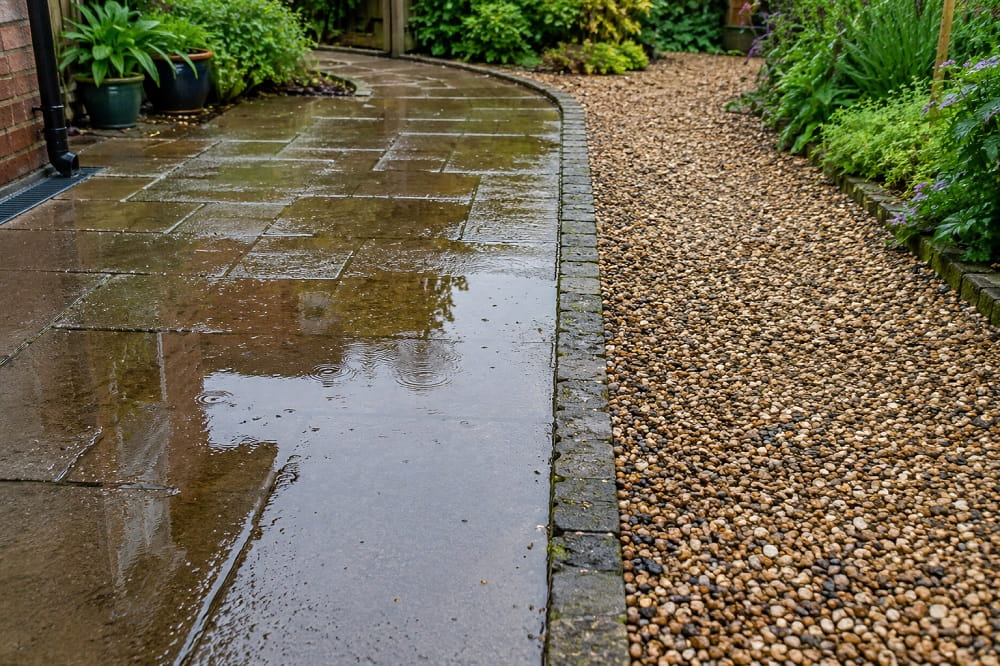
Drainage should be considered before colour, shape or price. A surface that sheds water in the wrong direction can cause puddles, algae, staining, frost risk, soil erosion or water movement towards buildings.
The RHS guidance on permeable paving explains that gardens can soak up rain, while less porous surfaces such as paving, tarmac and concrete increase runoff. That makes material choice part of water management, not just design.
Maintenance depends on the surface and the joints
Loose materials need topping up and edging. Pavers need joint care. Concrete can crack or stain. Natural stone may need careful cleaning and possibly sealing. The material itself matters, but so does the way it is installed and maintained.
Everyday usability matters
A path might need to suit children, older users, pets, bins, garden furniture, wheelbarrows or wet-weather access. A decorative stepping-stone route may be fine for occasional use but frustrating as the main route to a shed or gate.
Garden Path Materials Compared
Gravel paths
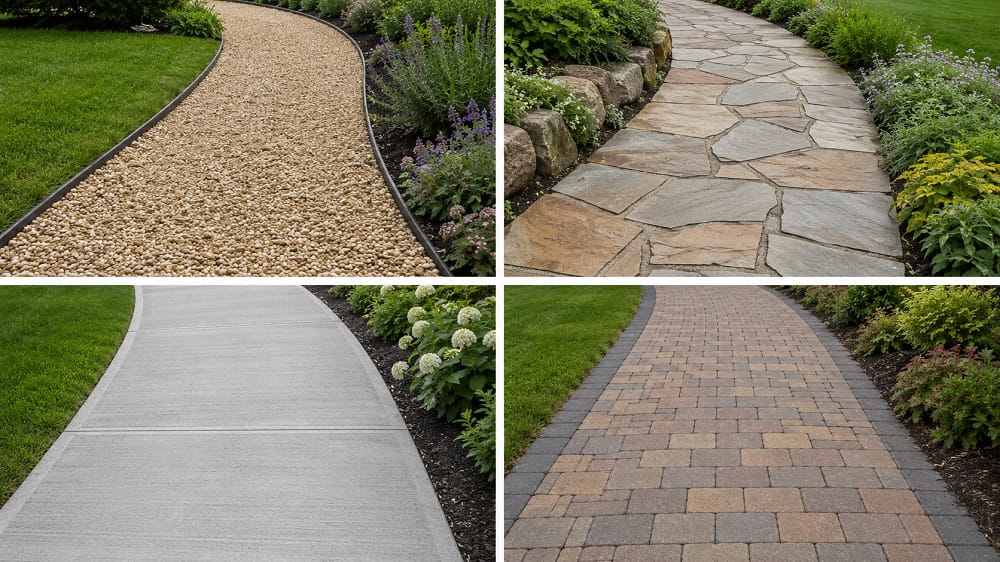
Gravel is one of the most flexible garden path materials. It is useful for informal routes, curved paths, cottage-style gardens, drainage-friendly designs and areas where you may want to adjust the shape later. It is generally more forgiving than rigid paving because water can drain through the surface when the base and edging are suitable.
The downside is movement. Gravel can migrate into lawns and borders, collect leaves, show wheel tracks and feel loose underfoot. It needs edging to keep it in place and may not be ideal for wheelchairs, pushchairs or high-frequency access routes unless stabilised with grids.
Natural stone paths
Natural stone gives a strong, high-quality look and works well in traditional, country and premium garden schemes. Sandstone, limestone, slate and granite all have different textures, colours and maintenance needs. A textured stone can provide better grip than a smooth surface, but suitability depends on the finish and where the path is used.
The downside is cost and variation. Stone can be more expensive than concrete options, and some types are more porous, more stain-prone or more sensitive to cleaning products. Natural stone paths need careful installation, suitable jointing and correct cleaning methods.
Concrete paths
Concrete can provide a firm, practical and durable surface. It is useful where the path needs to be stable, straightforward to clean and suitable for regular foot traffic. It can be plain, brushed, patterned or combined with edging for a more finished look.
The downside is that concrete is less forgiving if it cracks, stains or is laid without adequate movement and drainage consideration. Plain concrete can also look utilitarian unless designed carefully. Non-permeable concrete can increase runoff if water is not directed to a permeable area.
Pavers and block paving
Pavers and block paving offer a neat, modular path surface. They can be laid in patterns, repaired in sections and combined with edging, drainage and permeable systems. Pavers work well where you want a tidy path with more structure than gravel but more repair flexibility than a single concrete slab.
The downside is joint maintenance. Weeds, moss, settlement and joint loss can become issues if the base and jointing are poor. Permeable pavers can help with drainage, but only when installed as part of a permeable system, not simply laid on a standard non-draining base.
Comparison Table: Gravel, Stone, Concrete and Pavers
| Factor | Gravel | Natural stone | Concrete | Pavers / block paving |
|---|---|---|---|---|
| Typical look | Informal, natural, flexible | Premium, traditional or rustic | Practical, plain or modern | Neat, structured and modular |
| Drainage | Good when installed with a suitable base | Depends on joints, falls and installation | Often impermeable unless designed otherwise | Can be permeable if installed as a permeable system |
| Maintenance | Raking, topping up, weed control, leaf removal | Cleaning, joint care and possible sealing | Cleaning, crack monitoring and stain control | Joint care, weed control, cleaning and occasional repair |
| Everyday access | Can feel loose unless stabilised | Good if flat, textured and well laid | Firm and practical | Firm when installed on a stable base |
| Repairability | Easy to top up or reshape | Individual slabs can be replaced, but matching may be difficult | Cracks and repairs can be visible | Individual pavers can often be lifted and replaced |
| Best fit | Informal garden paths and drainage-friendly routes | Feature paths and premium garden designs | Practical routes needing a firm surface | Structured paths needing pattern, repairability and neat edging |
Decision Framework: Which Path Material Should You Choose?
1. How often will the path be used?
For daily routes to bins, sheds, gates or back doors, prioritise stability, grip and easy cleaning. Concrete, pavers or well-laid stone are often better than loose decorative stepping stones. Gravel can work if it is edged and stabilised properly.
2. Does water already collect there?
If the area is damp, low or slow to drain, prioritise a permeable surface or a design that directs water safely into planting or drainage. Do not use an impermeable surface to cover a drainage problem.
3. Who needs to use the path?
For pushchairs, wheelchairs, mobility aids or frequent wheelbarrow use, a firm and even surface matters. Loose gravel may be unsuitable unless stabilised. Irregular stone may be attractive but can create trip points if not laid carefully.
4. How much maintenance will you do?
If you want very low intervention, avoid materials that need frequent raking, weeding or delicate cleaning. If you are happy with seasonal upkeep, gravel and natural stone become more practical options.
5. Is the path in a front garden?
Pause before installing impermeable surfacing in a front garden, especially over more than five square metres. Planning and drainage rules may apply if water cannot drain through the surface or into a permeable area.
Step-by-Step: Choose a Garden Path Material
Step 1: Mark the route
Mark the path with a string, a hose or spray marker. Walk it in both directions. Check whether it feels natural, whether it is wide enough and whether it avoids awkward corners.
Step 2: Watch where the water goes
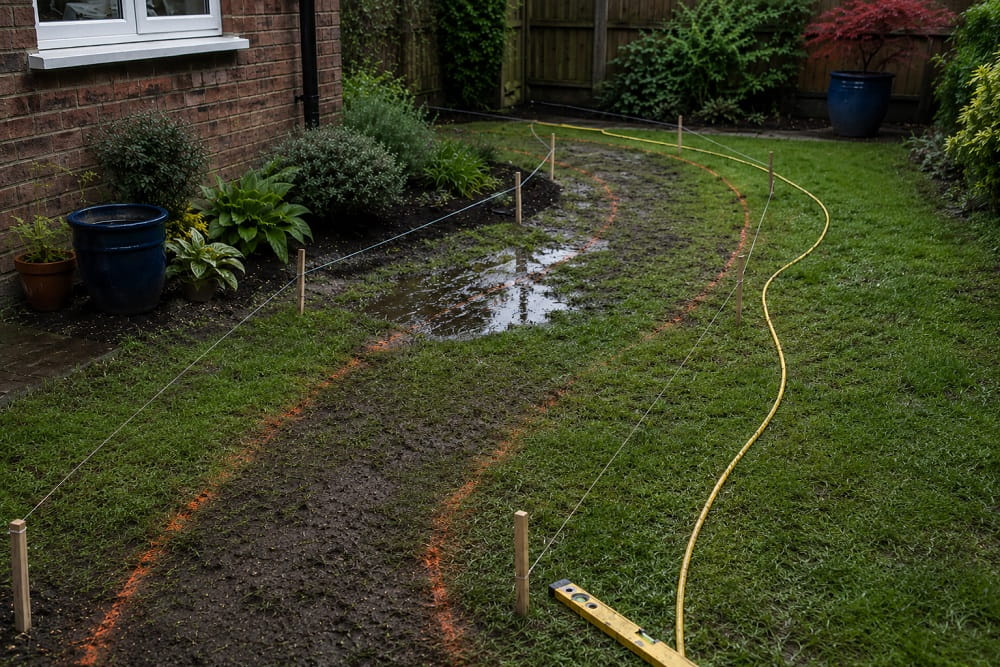
After rain, check whether water sits, runs across the route or flows towards buildings. This should influence both material choice and installation method.
Step 3: Decide the access level
Separate occasional decorative paths from daily access routes. The more often the path is used, the more important stability, grip and easy cleaning become.
Step 4: Choose the material group
Choose gravel for informal drainage-friendly paths, natural stone for feature paths, concrete for practical firm routes, and pavers for modular structured paths.
Step 5: Plan edging and base
Most path failures come from poor base preparation, weak edging or water movement. Do not choose the surface without planning what supports it underneath and along the sides.
Step 6: Plan maintenance
Decide how the path will be cleaned, weeded, topped up, re-jointed or sealed. A good material choice should match your maintenance habits, not just your design preference.
Common Mistakes
Choosing by appearance only
A path must be usable in wet weather, not just attractive in summer. Grip, drainage and maintenance matter as much as colour.
Ignoring the base
The surface is only as good as what sits beneath it. Gravel, stone, concrete and pavers all need suitable preparation if they are to remain stable.
Using loose gravel on high-access routes
Loose gravel can be awkward for bins, wheelbarrows, bikes, pushchairs and mobility aids. Use stabilisation or a firmer material where access needs are higher.
Letting water run towards the house
A path should not send rainwater towards walls, thresholds, air bricks or steps. Drainage must be considered before installation.
Forgetting joints and edges
Many paved paths fail at the edges or joints. Edging, jointing and weed control are part of the material choice.
Assuming a permeable surface means a permeable system
A permeable paver only works properly when the whole build-up allows water to drain. The base and jointing matter as much as the top layer.
Maintenance and Prevention
Gravel paths need raking, edging checks and occasional topping up. Remove leaves before they break down into soil, because soil encourages weeds.
Natural stone paths need regular sweeping and careful cleaning. Some stone may benefit from sealing, depending on porosity, finish and exposure. Avoid harsh cleaners unless the stone and product guidance allow them.
Concrete paths need cleaning, stain control and crack monitoring. Keep edges clear so water does not sit against the slab. If cracks appear, investigate whether movement, drainage or base failure is the cause.
Pavers need joint care, weed control and periodic cleaning. If blocks move or sink, the base or edge restraint may need attention rather than just replacing the visible units.
Your Next Step: DIY or Professional
DIY installation is usually suitable for simple gravel paths, small stepping-stone routes or light-use garden paths where levels are straightforward and drainage is not a problem.
Professional help is the safer route where the path needs levels, drainage, steps, retaining edges, wheelchair access, heavy loads, front-garden compliance or a long-term paved finish.
For wider path, patio and driveway surface-care options, use Path, Patio and Driveway. Choose products based on the material, surface condition and maintenance task.
Summary
Garden path materials should be chosen by use, drainage and maintenance, not appearance alone. Gravel is flexible and drainage-friendly but can move. Natural stone is attractive and long-lasting but needs careful choice and upkeep. Concrete is firm and practical but can increase runoff if not designed well. Pavers are neat and repairable but need good base preparation and joint maintenance.
The best path is the one that suits the route, users, water movement and maintenance routine. If water already collects, if access needs are high, or if the path affects front-garden drainage, pause before choosing the surface and plan the system properly.
Frequently Asked Questions
What is the best material for a garden path?
There is no single best material. Gravel suits informal and drainage-friendly routes. Natural stone suits premium garden designs. Concrete suits practical firm paths. Pavers suit neat, modular paths with repair flexibility.
Is gravel good for garden paths?
Yes, gravel can be a good choice for informal garden paths and permeable routes. It needs edging, occasional raking and weed control, and may not suit high-access routes unless stabilised.
Are stone paths slippery?
Some stone can become slippery, especially if smooth, shaded or affected by algae. Choose a suitable texture and maintain the surface regularly.
Is concrete better than paving slabs?
Concrete can be practical and firm, but paving slabs or pavers may offer better appearance, repairability or design flexibility. The better choice depends on use, drainage and budget.
Do garden paths need drainage?
Yes. Every path needs a plan for water. This may mean a permeable surface, falls away from buildings, drainage channels, or directing water into borders or lawns.
Do I need planning permission for a garden path?
Most rear garden paths do not need planning permission, but front garden paving can be affected by drainage rules if impermeable surfacing is used over larger areas. Check the Planning Portal if the path forms part of a front garden or driveway.
Which path material is lowest maintenance?
Concrete and well-laid pavers can be relatively low maintenance, but no path is maintenance-free. Gravel needs raking, stone needs careful cleaning, and pavers need joint care.
What should I avoid when choosing a garden path?
Avoid choosing by appearance alone, ignoring drainage, using loose materials on high-access routes, or laying any path without suitable edging and base preparation.

Path & Patio is a UK supplier of paving and landscaping products, sharing practical guidance, product expertise and installation advice for patios, paths and driveway projects.