
The Essential Tool Kit for Paving and Landscaping Contractors
Professional paving and landscaping depend on more than the materials being laid. A good finish comes from accurate setting out, controlled preparation, safe cutting, clean handling, consistent placing, tidy jointing and proper clean-up. The right tool kit helps a contractor work more efficiently, reduce rework and keep the standard of finish consistent from job to job.
A planned contractor tool kit should not be a random collection of tools in the back of a van. It should be built around the stages of work: survey, mark out, prepare, excavate, move materials, cut, place, finish, clean, protect and maintain. Safety equipment belongs in the same plan because dust, vibration, sharp tools and heavy materials are part of the work, not separate issues.
For contractor site tools, cleaning and surface preparation, fixing and clamping tools, adhesives, maintenance sprays and related equipment, use Contractors & Professional Tools. Use this guide first to decide which tool groups matter most for your work.
Quick Answer: What Should Be in a Paving and Landscaping Contractor Tool Kit?
- Safest default: build the kit by job stage, not by buying every tool at once.
- Start with reliable measuring, marking, levels and layout tools because poor set-out creates costly rework.
- Add preparation and handling tools for excavation, sweeping, scraping, moving materials and keeping the site organised.
- Use cutting and powered tools only where dust, vibration, guarding, PPE and user competence are controlled.
- Include cleaning, surface preparation and maintenance products so bonding, sealing, repair and finishing work starts on clean surfaces.
- Stop and get specialist help where the job involves structural drainage, major cutting, retaining work, public access or safety-critical construction.
What This Guide Does Not Solve
This guide does not provide a construction specification for patios, driveways, retaining walls, steps, drainage systems or commercial hardstanding. A tool kit can help with accuracy and workflow, but it does not replace correct design, levels, materials, sub-base specification, compaction or drainage planning.
It also does not train someone to use cut-off saws, grinders, compactors, breakers or other powered equipment. These tools can create serious dust, noise, vibration and injury risks. Tool ownership is not the same as competence.
This guide is intended for domestic paving and landscaping workflows. Commercial sites, public access projects, highway work and larger construction sites may require additional procedures, training, documentation and supervision.
When to Pause or Escalate
Stop before cutting paving, kerbs, flags, blocks or concrete if dust control, respiratory protection, eye protection, safe working space and user competence are not in place. HSE warns that using cut-off saws on paving, blocks and kerbs can produce very high levels of silica-containing dust, and that effective control is necessary because this work is high risk.
Pause before relying on hand-held powered tools for long periods without considering vibration exposure. HSE states that hand-arm vibration comes from hand-held power tools and can cause significant ill health, so tool choice, use time, maintenance and work planning matter.
Escalate to trained professionals or specialist contractors where the job involves structural retaining work, drainage correction near buildings, large-scale excavation, public access, vehicle-bearing surfaces, extensive cutting, unknown services, unstable ground or lifting beyond safe manual handling capacity.
Why a Planned Contractor Tool Kit Matters
It improves consistency
Consistent results come from a repeatable process. Measuring tools help confirm levels and dimensions. Marking tools reduce guesswork. Cutting guides and straight edges support cleaner cuts. Cleaning and preparation tools help surfaces accept adhesives, sealers and repair materials more reliably.
It reduces rework
Many outdoor projects go wrong early: layout lines are unclear, cuts are guessed, levels are checked too late, or surfaces are not prepared before products are applied. A planned kit helps prevent these avoidable problems.
It protects the finish quality
Finish quality is affected by clean edges, accurate cuts, stable bedding, controlled jointing and clean surfaces. Tools do not guarantee quality, but they support the workflow that produces it.
It keeps safety visible
Dust masks, eye protection, gloves, hearing protection, knee protection, dust suppression, guards and tool maintenance should not be afterthoughts. They are part of the kit because they affect whether the job can be done safely.
Essential Tool Kit by Job Stage
1. Survey, layout and measuring tools
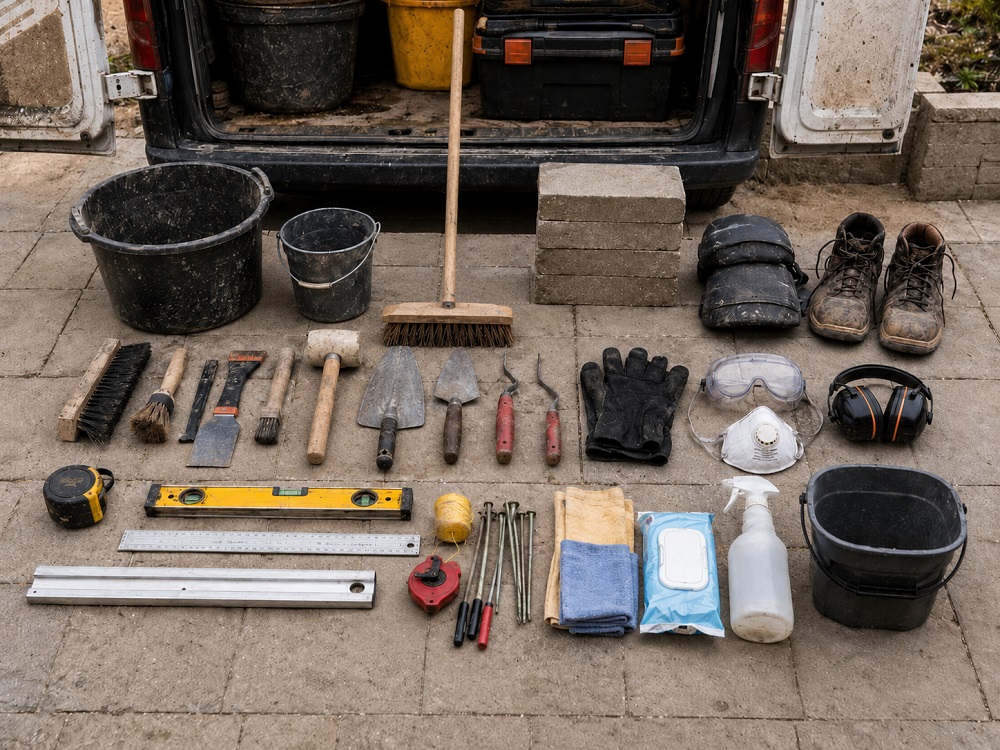
The first kit group should cover setting out. This includes tape measures, rules, marking pens, chalk lines, string lines, line pins, spirit levels, laser levels where appropriate, squares, straight edges and profile boards.
For marking, layout and alignment tools, use Marking and Measuring Tools. This is one of the highest-value tool groups because accurate marking prevents wasted cuts and awkward corrections later.
2. Preparation and excavation tools
Preparation tools include shovels, spades, forks, rakes, brooms, brushes, scrapers, buckets, tubs, wheelbarrows, debris bags and hand tools for clearing edges or old material. These are not glamorous, but they are used constantly.
For paving and landscaping contractors, preparation tools help control the site. They keep waste moving, surfaces clear and working areas safer. Poor preparation slows every later stage.
3. Material handling and access tools
Outdoor materials can be heavy, awkward and abrasive. A contractor kit should include gloves, lifting aids where appropriate, kneeling protection, buckets, boards, ramps, trolleys or wheelbarrows, and storage containers for smaller tools.
Handling tools should be chosen around the materials you regularly move: paving slabs, bags of sand, blocks, edging, jointing products, cement, aggregates and tools. Repeated manual handling should be planned, not improvised.
4. Cutting and shaping tools
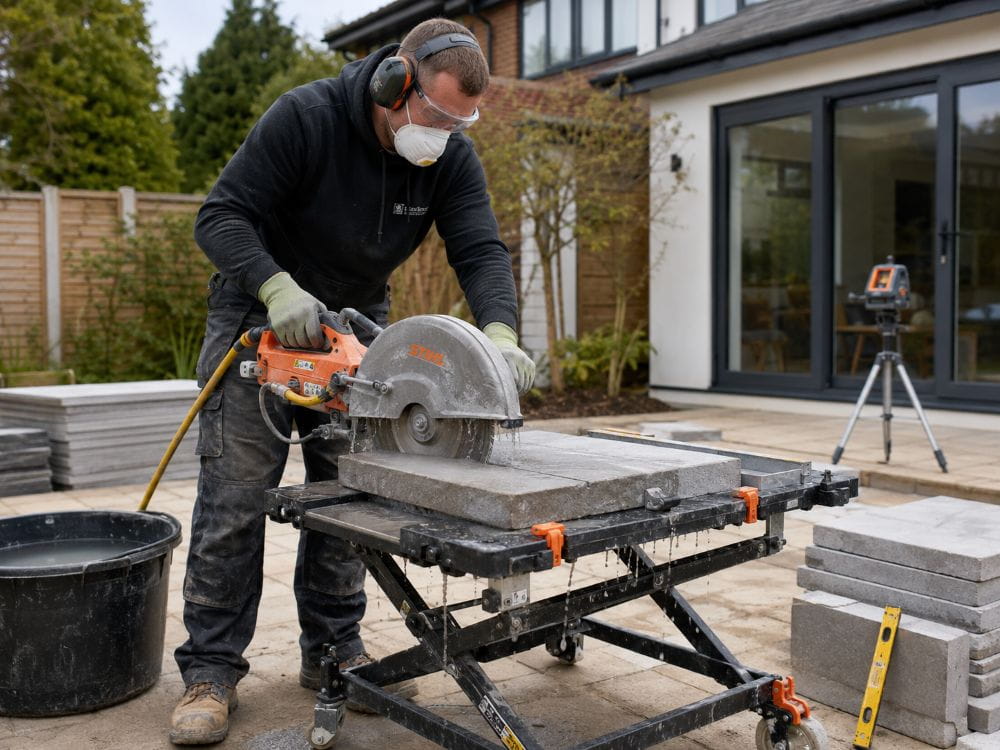
Cutting tools may include hand saws, grinders, cut-off saws, block splitters, masonry blades, trimming tools and guide rails, depending on the work. These tools have a major effect on finish quality, but they also carry a higher risk.
HSE guidance lists cutting paving blocks, kerbs and flags, chasing concrete, grinding and dry sweeping among construction tasks that can produce high levels of dust. This means dust control must be planned before the tool is used, not added after the first cut.
5. Placing, bedding and finishing tools
This group includes trowels, floats, pointing tools, jointing tools, rubber mallets, spacers, screeding rails, straight edges, compacting tools, brushes and finishing sponges where appropriate. These tools help with the visible quality of the final surface.
For patios, paths and driveways, finishing tools need to match the material. Porcelain, sandstone, concrete flags, block paving, edging and jointing compounds may need different handling and clean-down methods.
6. Fixing, clamping and alignment tools
Clamps, brackets, fixing tools, straight edges and temporary supports help hold materials in position while cutting, bonding or setting. This is especially useful for edging, timber elements, boards, trims, templates and repair work.
Good clamping reduces movement while working. That improves accuracy and reduces the temptation to hold materials dangerously by hand while cutting or drilling.
7. Cleaning and surface preparation tools
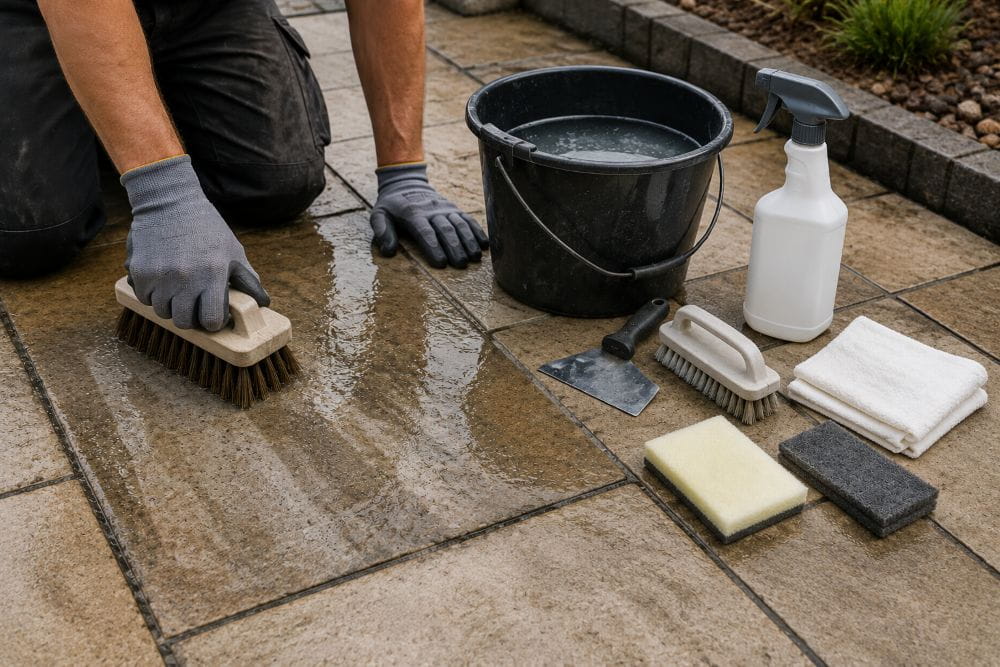
Cleaning and preparation tools include wipes, degreasers, brushes, scrapers, dust removal tools, cloths, buckets and surface cleaners. These are essential before applying adhesives, coatings, sealers, repair compounds or jointing materials.
For wipes, cleaners and preparation products, use Cleaning and Surface Preparation. This category matters because many product failures begin with dirty or contaminated surfaces.
8. Maintenance sprays and tool-care products
Lubricants, degreasers, penetrating oils, cleaning sprays and maintenance products help keep tools usable. A contractor kit should include products for cleaning, freeing stuck parts, protecting metal surfaces and maintaining moving components.
Tool care affects uptime. A seized clamp, blunt blade, dirty marker, clogged nozzle or stiff hinge can slow a job as much as a missing tool.
9. Personal protective equipment and risk controls
Safety equipment should include suitable gloves, eye protection, respiratory protection, hearing protection, knee protection and weather-appropriate workwear. For dust-generating work, respiratory protection should be part of a wider control plan, not the only control.
Powered cutting, grinding, breaking and compaction can also involve vibration, noise and flying debris. Battery tools are not automatically lower-risk; HSE research found battery-powered tools can have higher or lower noise and vibration emissions depending on the tool.
Comparison Table: Contractor Tool Kit Groups
| Tool group | Best for | Why it matters | Main caution | Best Path & Patio route |
|---|---|---|---|---|
| Marking and measuring | Layout, levels, cut lines and fixing points | Reduces rework and wasted materials | Marks only help if measurements are checked | Marking and Measuring Tools |
| Preparation tools | Clearing, scraping, sweeping, excavation and site organisation | Keeps later stages cleaner and more efficient | Do not treat preparation as optional | Contractors & Professional Tools |
| Cutting and shaping tools | Blocks, slabs, trims, edging and hard materials | Improves fit and finish where cuts are unavoidable | Dust, noise, vibration and blade risk | Contractors & Professional Tools |
| Placing and finishing tools | Bedding, levelling, jointing and final surface finish | Controls visible quality and consistency | The wrong tool can damage the surface or the joint | Contractors & Professional Tools |
| Cleaning and surface preparation | Before bonding, sealing, repair or coating | Reduces product failure from contamination | Check surface and product compatibility | Cleaning and Surface Preparation |
| PPE and risk controls | Dust, noise, vibration, sharp edges and impact risk | Protects users and supports compliant working | PPE does not replace dust control or training | Contractors & Professional Tools |
Decision Framework: What Tools Should You Buy First?
1. What jobs do you repeat most?
Buy around repeated work first. If you regularly install patios, measuring, marking, levelling, cutting, jointing, and cleaning tools are essential. If you mostly do garden clearance, handling, cutting, pruning and waste-management tools may come first.
2. Which tools reduce rework?
Tools that prevent mistakes are often better value than tools that only speed up work. Good marking tools, levels, straight edges and surface-preparation tools often save more money than a rarely used specialist item.
3. Which tools improve finish quality?
Finishing tools should match the type of work. Paving, porcelain, natural stone, block paving, timber edging and jointing compounds all require different levels of care. Choose tools that help control the surface rather than damage it.
4. Which tools reduce safety risk?
Dust control, PPE, lifting aids, guards, clamps and maintenance tools should be treated as a core kit. If a tool makes cutting, holding, lifting or cleaning safer, it belongs in the buying plan.
5. Does the tool require training or documentation?
Pause before buying or using powered cutting, grinding, compacting or breaking equipment unless the user is competent and the dust, vibration, noise and guarding risks are understood. A powerful tool used badly can create more cost and risk than it saves.
Step-by-Step: Build a Practical Contractor Tool Kit
Step 1: List your core services
Write down the work you actually carry out: patios, paths, driveways, fencing, decking, repair work, jointing, cleaning, sealing, garden clearance or general landscaping. Your tool kit should follow your service list.
Step 2: Map each service by stage
Break each service into survey, mark-out, preparation, cutting, placing, finishing, clean-up and maintenance. This exposes missing tools and duplicate tools quickly.
Step 3: Prioritise accuracy tools
Invest first in measuring, marking, levels, straight edges and layout tools. These protect materials and reduce rework.
Step 4: Add preparation and clean-up tools
Include brooms, brushes, scrapers, buckets, wipes and surface-preparation products. A clean work area improves both safety and finish quality.
Step 5: Add specialist tools only where justified
Specialist tools are useful when used often enough to justify storage, maintenance and training. Otherwise, hiring or subcontracting may be better.
Step 6: Build safety into the kit
Add PPE, dust control, blade guards, clamps, first-aid basics and tool-maintenance items. Safety equipment should travel with the tools that create the risk.
Step 7: Review after each job
After each project, note which tools saved time, which tools were missing and which tools stayed unused. A contractor kit should evolve from real work, not guesswork.
Common Mistakes
Buying tools before defining the workflow
A large tool kit can still be inefficient if it does not match the work. Build the kit around job stages and repeated tasks.
Underestimating dust from cutting
Cutting paving and concrete products can create serious respirable dust. Do not rely on a mask alone where the cutting method, water suppression, extraction and working area have not been planned.
Ignoring vibration exposure
Repeated use of grinders, breakers, compactors and powered tools can create hand-arm vibration risk. Tool choice, maintenance and use time matter.
Using hand pressure instead of clamps
Holding materials by hand during cutting or drilling is a common shortcut. Clamps and supports give better control and reduce injury risk.
Neglecting cleaning and surface preparation
Adhesives, sealers, coatings and repair products can fail on dirty or contaminated surfaces. Cleaning and preparation tools are part of the finish-quality kit.
Letting tools become disorganised
Tools that cannot be found waste time. Use boxes, racks, pouches or van storage so high-use tools have fixed locations.
Maintenance and Prevention
A contractor tool kit needs maintenance just like the surfaces being installed. Clean tools after use, dry metal parts, lubricate moving components where suitable, replace worn blades and keep measuring tools protected from damage.
Inspect powered tools before use. Check guards, cables, batteries, handles, discs, blades, vibration, noise and signs of overheating. Remove defective tools from use until repaired or replaced.
Keep marking tools, levels and measuring tools clean and protected. A damaged level or worn marking tool can cause expensive mistakes.
Store dust-generating tools, cutting accessories and PPE together so the controls are available when the work starts. Do not let safety equipment become separated from the task that needs it.
Your Next Step: DIY or Professional
DIY users and small contractors should start with a focused kit: measuring, marking, levels, hand tools, brushes, scrapers, buckets, PPE and cleaning/preparation products. Add powered or specialist tools only when competence and risk controls are in place.
Established contractors should standardise kits by job type. A paving kit, fencing kit, decking kit, cleaning kit and repair kit can reduce setup time and prevent missing tools on site.
Professional help or subcontracting is the safer route where cutting, structural work, drainage, retaining walls, commercial access, heavy lifting or specialist machinery is beyond the team’s competence or equipment.
Summary
The essential tool kit for paving and landscaping contractors is not just a list of tools. It is a workflow system. Start with measurement and marking. Add preparation, handling, cutting, placing, finishing, cleaning and maintenance tools. Include PPE and risk controls from the start.
The best tool kit improves accuracy, reduces rework and supports safer working. It should match the services you actually provide, the risks you regularly face and the finish quality your customers expect.
Frequently Asked Questions
What tools does a paving contractor need first?
Start with measuring, marking, levels, string lines, straight edges, preparation tools, brooms, scrapers, hand tools, PPE and cleaning equipment. Add cutting and powered tools only where competence and dust control are in place.
Are marking and measuring tools really that important?
Yes. Poor layout causes wasted cuts, awkward edges and visible mistakes. Accurate marking and measuring tools are usually among the highest-value tools in a paving kit.
What tools help improve finish quality?
Levels, straight edges, trowels, floats, jointing tools, clean brushes, finishing sponges, clamps and surface-preparation tools all help control the finished result.
Should every contractor own cutting equipment?
Not always. Cutting equipment requires competence, dust control, PPE, maintenance and safe working space. Hiring or subcontracting may be safer where cutting is occasional or high risk.
What safety equipment should be included?
Include suitable eye protection, gloves, hearing protection, respiratory protection, knee protection and task-specific controls such as dust suppression or extraction where needed.
How do I organise contractor tools?
Group tools by job stage or service type. Keep marking tools, cutting tools, finishing tools, cleaning products and PPE in clear, repeatable locations.
How often should contractor tools be checked?
High-use tools should be checked before use. Powered tools, cutting equipment, levels, clamps and PPE should be inspected regularly and removed from use if damaged.
What is the best product route for contractor tools?
Use the Contractors & Professional Tools category as the main route, then narrow down to marking and measuring, cleaning and surface preparation, fixing and clamping, adhesives or maintenance sprays based on the job.

Path & Patio is a UK supplier of paving and landscaping products, sharing practical guidance, product expertise and installation advice for patios, paths and driveway projects.